Why is SUNY-B Watching You? On campus, in town, and across the country?
AI generated
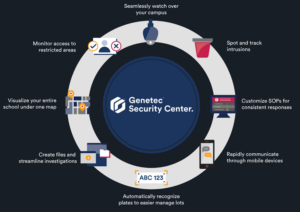
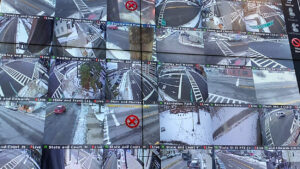
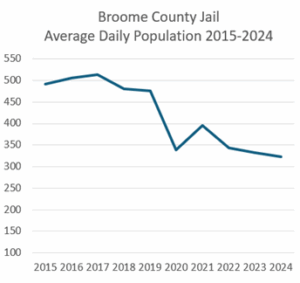
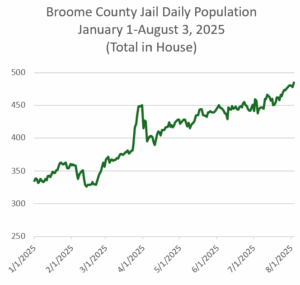
After the 450 people held in the county jail, who are the most surveilled group in Binghamton? It’s surely SUNY-Binghamton University students. As a recent article in the student newspaper Pipedream recounted, the campus administration has deployed over 1600 cameras and 4,800 access/card readers tracking 18,000 students, 1250 faculty and 2,000 support staff. Cameras and sensors once isolated from each other now function as a single interlinked system, driven by AI software from the Montreal-based firm Genetec.
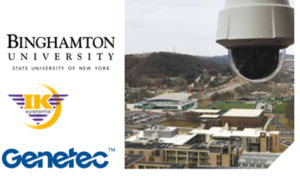
It’s a vast network encompassing facility access, biometric data, automatic license plate readers, video/camera streams, and communications. Genetec reports the system is overseen by nine staff located in two security centers. Rumors abound about the control room: is it really the “Bat room” in the basement of the library tower?
Genetec proudly advertises its Binghamton system as an integrated, comprehensive model for other campuses.
But ask SUNY-Binghamton administrators or SUNY system officials in Albany about surveillance and the answer is: we have nothing, we know nothing, about Genetec or such things.
Identifying and Targeting Protest by AI
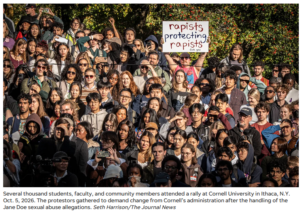
Campus and Genetec officials can be quite blunt about a primary aim of the network: to proactively detect rallies, protest, and demonstrations. In 2024 it took state troopers, County Deputies, and the campus police force to expel pro-Palestinian protestors from the lawn across from the administration building. Today Genetec promises to detect gatherings before groups coalesce. As Dave Martin, Assistant Director of Security Infrastructure and Support stated in a recent Genetec press release, “if a group hits a certain size, the video analytics tools preemptively alert us.” SUNY-Binghamton is only one of many campuses, including nearby Cornell, that deploys Genetec to these ends.
Indeed AI-controlled sensors now aim to wash away historic waves of protest by students and faculty, wiping out a long tradition. No more antiwar marches from campus to downtown Binghamton along the Vestal Parkway, blessed by the President no less, as happened in May 1970.
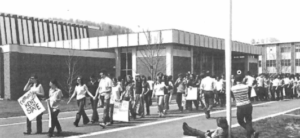
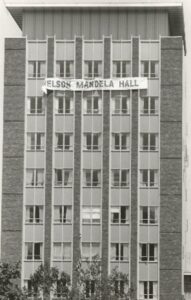
No more occupations of the administration building in protest of SUNY’s investments in South African apartheid as in 1985.
No more gatherings in open spaces as in spring 2017 when students occupied the public lobby of the administration building, demanding less policing, less surveillance, and more mental health counseling. This was a turning point: President Stenger dictated no meeting or discussions with students could take place, closed all offices in the building and dispatched campus police to patrol its corridors until students left the lobby at the end of the semester.
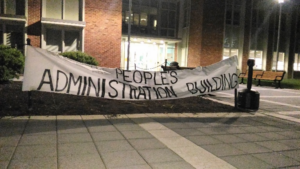
Blue Lights Occupation May 2017 Photo: William Martin
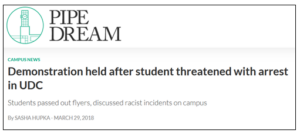
A harder stance was taken a year when later a Binghamton University Police Department (BUPD) officer was dispatched to threaten a student with arrest for handing out leaflets against racism in the Binghamton Downtown Center.
And when a protest against genocide in Gaza took place downtown in 2024?

The Center’s doors were protected by a phalanx of BUPD officers and patrol cars as protestors gathered across the street.
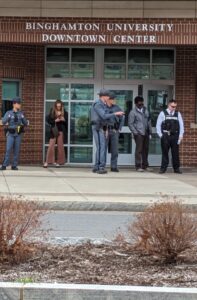
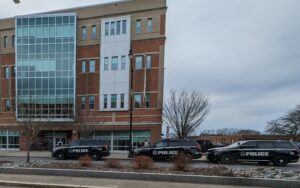
Photo: William Martin
Creating the surveillance university
The surveillance campus has been incrementally built over several decades. By the closing decade of the 20th century security cameras, blue light alert stations, and, after a January 29, 1999, decision by the University President, armed police were already ubiquitous. Cameras proliferated everywhere, outside dorms, at food stations, and on OCC buses. Few believed cameras were ever monitored by security, there were just too many of them.
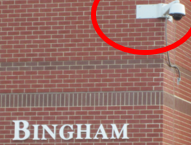
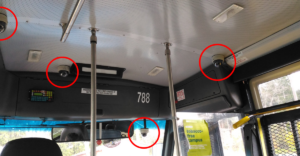
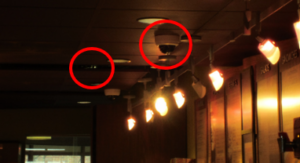
Bingham Hall, OCC Bus, Jazzman’s Cafe Photos: William Martin
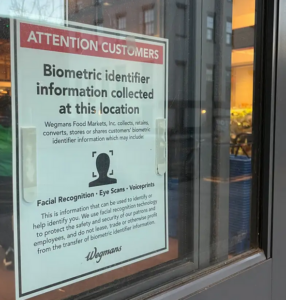
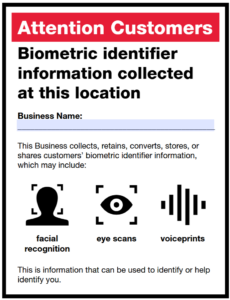
A new technological era emerged with biometric sensing and data tracking. One of the first signs was the appearance of a single fingerprint reader on the turnstile entering the East Gym in 2009. Register your fingerprint with security and you would not need an ID card to enter.
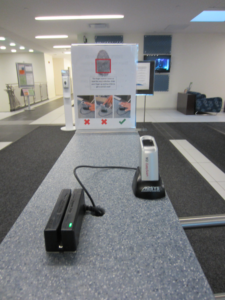
Photo: William Martin
Activists and faculty were quietly alarmed, suspecting this would soon be a new form of mandatory surveillance. A second mandatory fingerprint reader was soon placed at the gate to Fitspace, the weight and exercise machinery room.
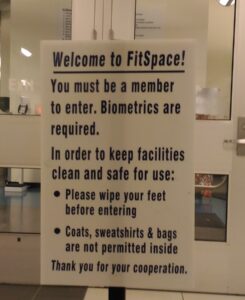
Photo: William Martin
Some faculty stopped using Fitspace. And then the fingerprint sensor was replaced by a more cumbersome biometric access pad that remains today and entails a scan of all five fingerprints and the input of one’s eight-digit ID number.
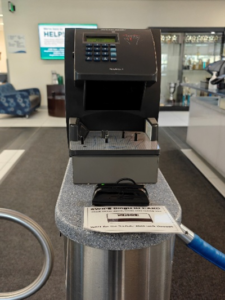
Photo: William Martin
Then came license plate readers, tracking everyone going and coming at all entrances to the campus and across all parking lots.
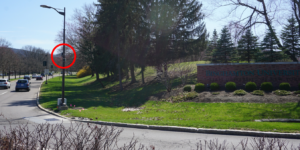
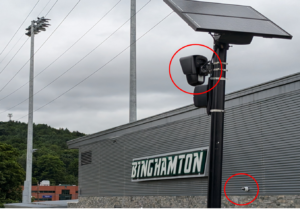
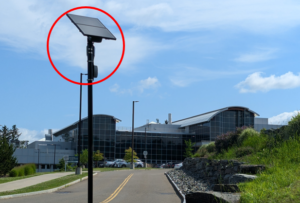
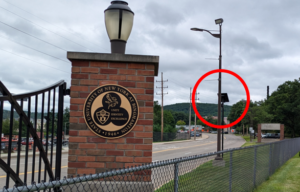
Campus Entrances Photos: William Martin
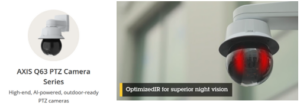 New Cameras from Axis Communications now capture details in color and across the spectrum, something that never could have been done with old analog cameras. “It’s amazing how good they are,” says BUPD Deputy Chief Reilly in an Axis promotion for the system. Cameras mounted on the highest building on the main Vestal campus, the Library Tower, can reach and spot persons and vehicles miles away.
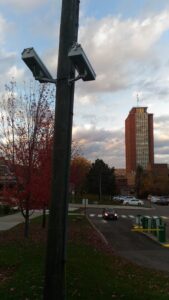
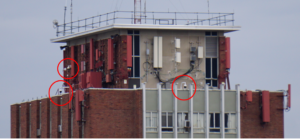
Photos: William Martin
Walk into the UHS clinics across from the campus on the Vestal Parkway and you can see the tower and it can see you.
Sensors also dot the new 15-acre Johnson City Pharmacy School and Nursing School complex, with cameras and license plate readers aimed at heavily travelled public streets and nearby housing complexes.
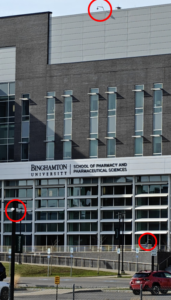
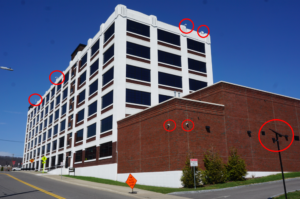
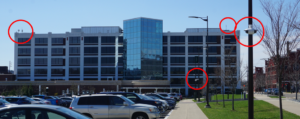
Photos: William Martin
With the opening of a University Downtown Center in Binghamton came armed guards: enter and you confront a desk staffed by BUPD officers. That’s frightening for some people: one formerly incarcerated person came face to face with a BUPD policeman who had been her correctional officer in a state prison (which for many made the Downtown Center off limits for future justice-related meetings). As of July 9, 2025, members of the public with scheduled meetings can enter only after their host approves them on arrival.
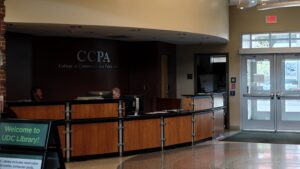
Photo: William Martin
Whose Data?
Privacy and free speech activists from the Electronic Frontier Foundation to the ACLU ask: who gets the data, where is it stored, for how long, and with whom is it shared? Specific companies have been targeted by campus and community activists, as in the DeFlock campaign which recently succeeded in having cameras actually removed in Ithaca and the Tompkins County Legislature recently voted to terminate their Flock contract. But SUNY-Binghamton? The answer is we don’t know the answer to any of these questions and the Binghamton and SUNY-Central administrations have long resisted any effort to find out.
When I returned to Binghamton as a faculty member in 1999 I inquired if, as I had discovered at the University of Illinois, the University could read all binghamton.edu emails without a warrant given they owned the email domain. I was told no warrants were ever needed, access was open for campus officials. This became of apparent use when the administration investigated athletes of color and Athletic Department officials during the 2009 basketball scandal that led to President DeFleur’s resignation. When biometric measures were more openly introduced at the East Gym in 2009, I asked where the data was kept, distributed, and who managed it? The request was denied for “security reasons.”
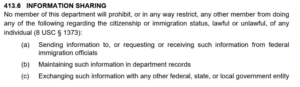
Fifteen years and a lifetime of IT development later, even the barest pretense of transparency has disappeared. New University policies following pro-Palestinian encampment act to ensure unfettered collection and distribution of data. As on many campuses, protestors during the Gaza encampment suspected the university could track their digital activity and location through the campus’ eduroam Wi-Fi network. University privacy policies now bluntly declare that “Binghamton University may preserve, access, monitor, or disclose information containing all classes of data.” And if the FBI or New York State or campus official wants information? “An attorney in the office of University Counsel may request data custodians conduct targeted searches of electronic files to find material relevant to the disclosure request.” There is no requirement that people be notified if their files are read and distributed to local, state, or federal officials. Has campus data and video been shared with just local law enforcement? They don’t say, we aren’t to know.
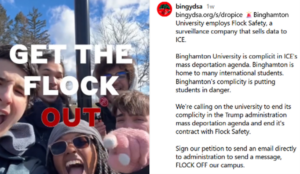
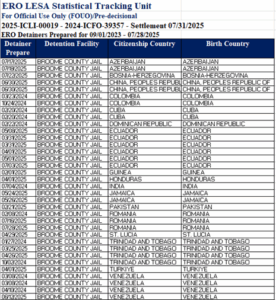
We do know that Flock license plate readers and Axis cameras are widely used across the campus, while Genetec coordinates both hardware and software. Revelations of Flock and other companies sharing data with law enforcement and Homeland Security/ICE are widely reported. The Deflock campaign has published an incomplete map of Flock cameras in the Binghamton area, while the Electronic Frontier Foundation has issued an incomplete data list from public sources of cameras and sensors. Local media report the University’s Flock cameras track cars on off-campus streets, as is indeed apparent if you visit the borders of the Johnson City and downtown Binghamton campuses; on this point campus officials refuse to answer media inquiries. Ithaca students have rallied against Flock as have Binghamton students who argue the cameras are particularly dangerous for international students given recent local ICE arrests and the large number of ICE detainees, including Long Island teenagers, held in the Broome County jail.
Update: SUNY-Binghamton rally against Flock as reported in the campus newspaper, Pipedream (May 4, 2026): Protesters rally against Flock Safety on campus. And students battle to bring the Student Association on board: SA Congress votes against Flock Safety resolution
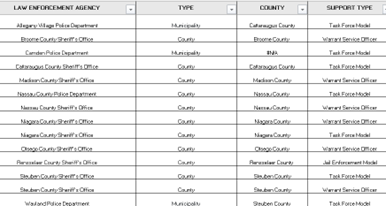
State law says we should know more. SUNY is a state agency, subject to the Freedom of Information Law (FOIL) which requires responses within 5 days to requests for records on financing, staffing, and contracts. What might one ask for? Axis and Genetec tell us of reach of the cameras and sensors, but not their cost, contracts, staffing, and memorandums on the storing and sharing of information. FOIL requests to local municipalities and the County Sheriff have generated sample copies of funding applications and state contracts (see here).
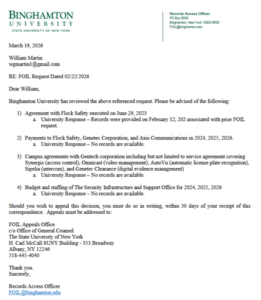
Binghamton University effectively denies all such requests. A FOIL request from January 8, 2026 requesting copies of contracts with Axis, Vigilant, Flock, and Genetec generated a February 12, 2026 response containing a minor three-year old contract for Flock, a denial of any Vigilant contract, and inoperable links to the essential Genetec contracts managed by SUNY system offices in Albany. Nothing on Genetec or Axis could be found.
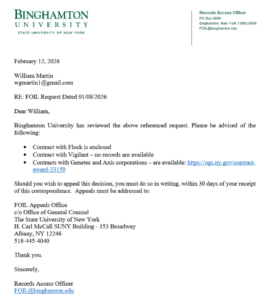
A follow-up FOIL for more specific contracts and staffing listed in Genetec postings generated a curt claim that nothing more existed.
An appeal sent to the Office of General Counsel for SUNY in Albany–the reported holder of Genetec and other surveillance contracts–was rejected as well. No contracts or staff or funding seem to exist for, in the words of Genetec’s published Binghamton Case Study, the “Two Campus Security Centers” staffed with “a 9-person team”. Apparently, they don’t exist.
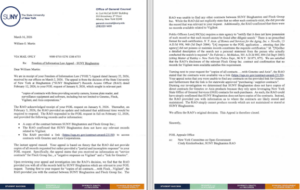
[Full text for these FOILs is located here.]
Beyond Binghamton: Intelligence Centers
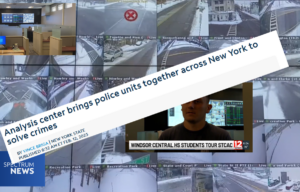
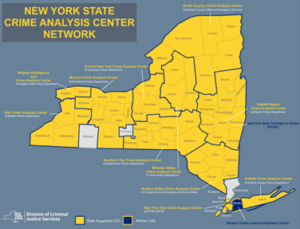
SUNY-Binghamton’s surveillance system isn’t exceptional: Binghamton is but one node in a national policing and surveillance network. The initial coordinating work locally is done behind closed doors, in an intelligence collection center, euphemistically labelled the “Southern Tier Crime Analysis Center” (STAC) located in the basement of the Binghamton Police Department.
STAC was created with millions of dollars from New York State and local governments. Official accounts tell us that STAC is linked to ten other Centers in New York State, 450 local, state, and national agencies, and then onward to the national Fusion Center intelligence network with direct integration to federal police and intelligence agencies including Homeland Security, the FBI, ICE, the NSA, and the CIA.
To what extent are data from SUNY-Binghamton license plate readers, optical cameras, and biometric and other sensors integrated with and automatically passed on, stored in, and distributed via STAC? Can other agencies draw upon SUNY-Binghamton data at will? What do the agreements and memorandums of understanding (MOUs) between police agencies, the STAC, and SUNY permit? SUNY-Binghamton and the SUNY central administration in Albany won’t tell us.
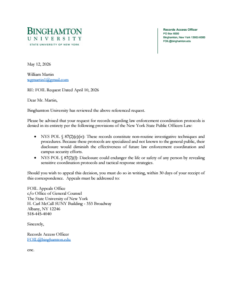
From other sources we do learn the University Police Department is a full member of STAC. A 2021 press release from the New York State Division of Criminal Justice Services reveals that one of the Directors of STAC is from SUNY-Binghamton and a BUPD officer is assigned to STAC. What do they do? We don’t know. The campus website on “public safety” notes that memorandums of understanding have been signed by the BUPD with STAC and all local police agencies and the State Police. What do these say, how much data is shared, who pays whom and for what? We don’t know. A January 2026 FOIL request to SUNY-Binghamton for a copy of any memorandum of understanding with STAC was bluntly refused: “Please be advised that your request for records is denied on the basis that if the information were to be disclosed, it would jeopardize the capacity of an agency or an entity that has shared information with an agency to guarantee the security of its information technology asset” (January 30, 2026 SUNY-Binghamton response here). A later FOIL request to the University for existing MOUs with police agencies was bluntly “denied in its entirety”. The reason? “Their disclosure would diminish the effectiveness of future law enforcement coordination.“
 A Broome County budget resolution reveals however that a memorandum of understanding does exist with the County sharing data back and forth with all local law enforcement agencies operating through STAC, including the Binghamton University Police Department. An Axis Communications promotional case study tells us moreover that local police agencies do rely upon and do access campus cameras and video. STAC in turn is linked to campus daily: it is the source of regular campus alerts to students of nearby police actions and crime reports in town. To be sure, this is a one-way street: no such warnings are provided to residents or youth in Vestal, Johnson City, or Binghamton.
Whose Public Safety?
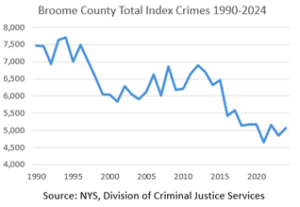
The press, police departments, and campus administrations justify the vast expansion of mass surveillance and policing to ensure “public safety”. But is that their purpose? Does more policing and surveillance prevent harm and violence and assist students, particularly as the Blue Lights protestors raised in 2017, in relation to the major campus dangers of suicide, sexual violence, and racial abuse? Data from State and campus officials suggest they do not, can not. Consider crime levels and the crimes faced by students. In Broome County index (serious) crime has been falling for over 30 years.
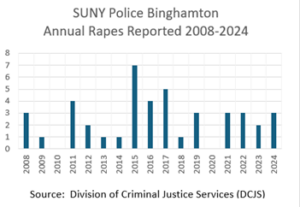
And on the campus? Every university police force reports crime statistics to state and federal agencies. SUNY campuses including Binghamton regularly report unbelievably low crime levels, reflected in national data studies that conclude campus crime is “statistically insignificant” (W. D. Allen 2021, 10). No statistics on suicide, a major cause of death of students, are ever reported. And what do we make of the commonly cited statistic that “an estimated one in five women has been sexually assaulted during her college years” (Obama 2014)? You won’t’ find any remotely comparable evidence in campus crime reports. Binghamton with 18,000 students regularly reports zero to less than a handful of rapes per year.
And students and faculty of color, those vastly overrepresented among those few arrested on the Binghamton campus? Faculty and student organizations writing to the President repeat survey findings that an “overwhelming percentage of the Binghamton faculty–67 percent of Black males, 60 percent of Black females and 50 percent of Asian females” had experienced racial discrimination and harassment as had “67 percent of Black males, 57 percent of Black females followed by 25 percent of Native American Females.” Yet the number of hate crimes officially on campus? Zero, year after year in SUNY-Binghamton’s annual federal crime report.
There is a seeming paradox here: despite rising surveillance and policing, the crimes most feared by students hardly ever happen officially. Yet calls and funding for more police, surveillance, and enclosure of campus spaces accelerate. Why such enclosures and surveillance if the results are so meager? One explanation is offered by analyses of “governing by fear”, instilling anxiety and fear to ensure compliance and secure administrative and state authority. One might alternatively argue, as does Binghamton PhD. graduate Brendan McQuade in Pacifying the Homeland, that intelligence centers and surveillance mark a transition from the use of mass policing and mass incarceration to social regulation by surveillance. Seen from these perspectives, the pursuit of “campus safety” is an Orwellian construction, fed by fabricated stories designed to induce fear and the acceptance of authoritarian practices.
The geography of surveillance, crime, and punishment we see in Binghamton and other elite campuses offers an additional insight, as surveillance not simply pacifies and regulates student and faculty populations but also serves to separate elite spaces from surrounding streets, neighborhoods, and especially poorer urban neighborhoods. As the nation’s wealthier campuses like Princeton, Columbia and the University of Chicago have expanded outward in recent decades, gentrification has nestled college students into areas of heavily policed poor communities and youth. SUNY-Binghamton’s opening of new campuses and housing in downtown Binghamton and Johnson City exemplifies this process locally. This is a manufactured opposition between “town” and “gown,” produced by a generation state policy and funding. New York State has effectively created two separate streams of youth headed from New York’s urban centers to upstate towns: one group moving to upstate SUNY colleges, and another, poorer, stream destined for state prisons.
The surveillance campus arises from these fears and realities, reproducing carceral and educational inequalities in a deadly symbiosis to the disadvantage of all youth involved. We need not accept this imposed script. We do need to investigate, understand and dismantle it. Removing Flock cameras and the collection and distribution of campus and municipal data collections is a start, a bare beginning.
The colonial world is a world cut in two. The dividing line, the frontiers are shown by barracks and police stations.
Frantz Fanon, The Wretched of the Earth
Related commentaries:
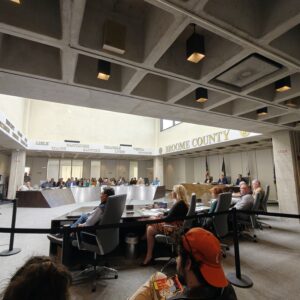
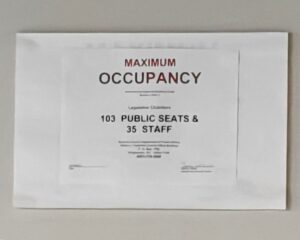
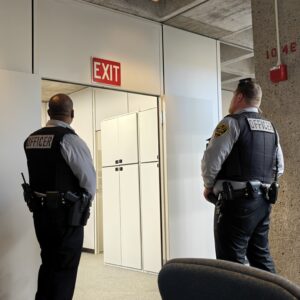
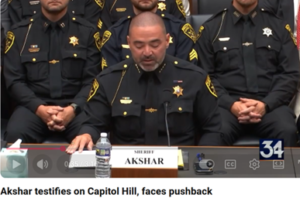
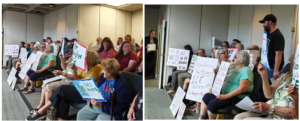
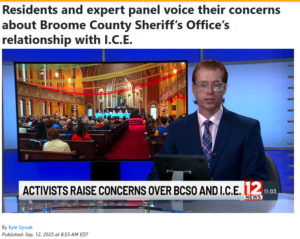
 A representative of the local community organization Humans of ICE spoke sharply and eloquently.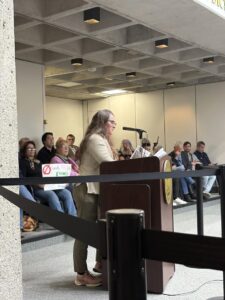
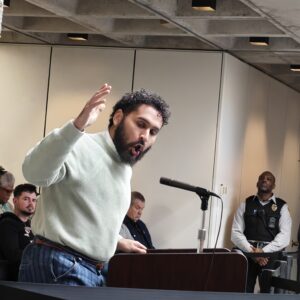
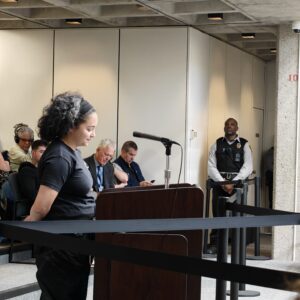

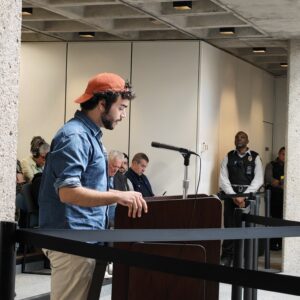 Another speaker carefully laid out the misspent funds on reentry services, with hundreds of thousands of $ allocated for such services while the sheriff dropped off teenagers late at night at a local church with no assistance or follow up (despite public claims to the contrary).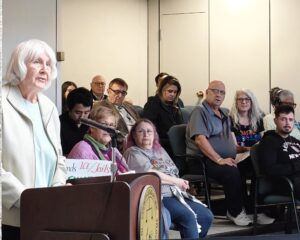
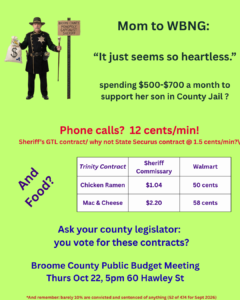


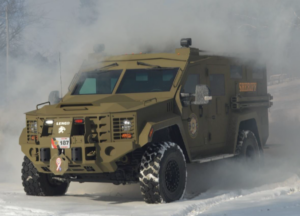
 Dig deeper and there are further surprises: Broome County gets a new Bearcat! No, not a star recruit for the local State University of New York’s Bearcat athletic teams, but $360,000 for another armored personnel carrier (
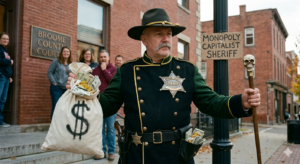
 AI generated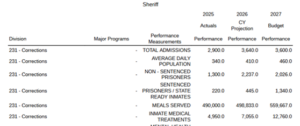
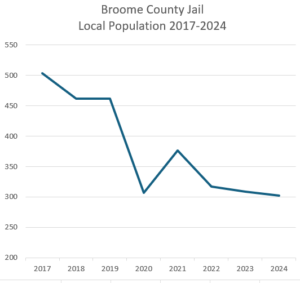
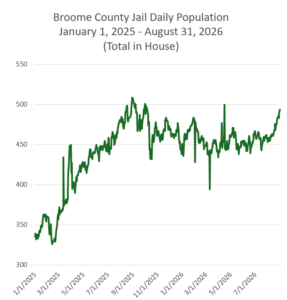
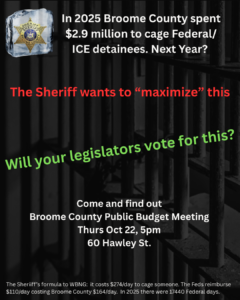
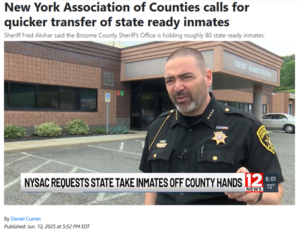
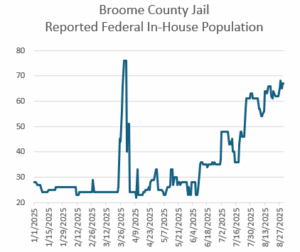
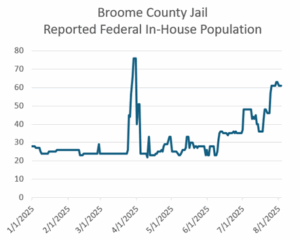
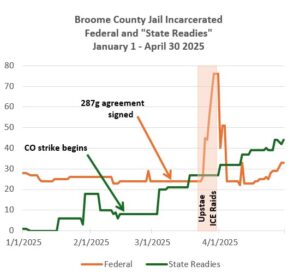
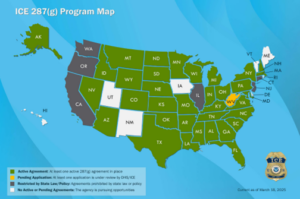
 Trump’s war against migrant workers was expected to help keep the jail full. Not because of the Sheriff personally signing a 287g agreement with ICE to serve detainee warrants, but by simply continuing a 2002 agreement to house Federal prisoners which had long been used to sustain county cooperation with ICE and house ICE detainees. It is this agreement with the U.S. Marshalls Service that conservative New York State Sheriffs and Akshar defend. New York State’s new law against cooperation with ICE may lead to the termination of housing all federal prisoners, like the local dairy worker held at county expense for six months in the Broome County Jail on solely immigration charges. And lots of Federal funding is at risk for Sheriffs. Indeed Sheriffs report they make money from the Federal reimbursement of $110/day per person. Among the Sheriff’s 2027 Objectives in his budget statement: “Maximize available housing capacity to generate revenue through agreements with the U.S. Marshals Service, U.S. Immigration and Customs Enforcement (ICE), and other New York State counties” (p.236). By Sheriff Akshar’s own formula, however, the cost of boarding in a person is $274/day, meaning the county loses $164 for every Federal detainee every day. For 2025 this totaled
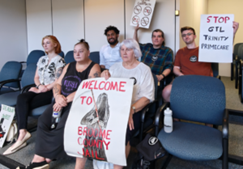


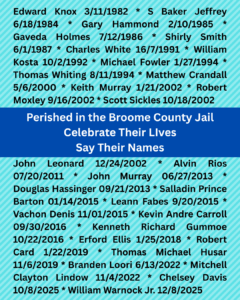
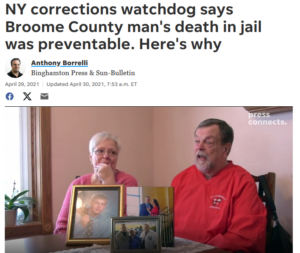 How much $ has the county paid out by lost lawsuits paying lawyers and then victims of abuse and wrongful deaths? We don’t know and they won’t tell. The county hides this: the cost of legal fees and payments has never been revealed much less reported; it is likely to be in the $ millions. Unless sealed by a judge, non-disclosure agreements can’t be used to hide payouts as in the most recent ruling in favor of the Husar family. But despite rulings by the NY State’s Committee on Open Government, the District Attorney’s office refuses to reveal payouts.
 A year later the
 AI generated
 At the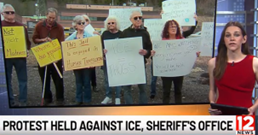








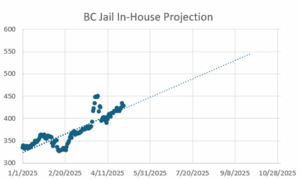
 Recent overcrowding in the jail due in large part to an expanding influx of ICE and Federal detainees has put yet further pressure on medical care. As



 Local newspapers in






Recent Comments